

The journey
to yourself.
There are times when your own desires become almost inaudible. Safety, caring for loved ones, the need to keep working and live with uncertainty all take priority. The question “What do I want?” gives way to another: “What do I need to do today?”
War changes a woman’s everyday life. It can take away her home, separate her from those she loves, and place on her shoulders responsibilities once shared by two. Even familiar rituals, choosing a dress, tying a scarf, lingering in front of the mirror, can sometimes feel out of place. As though she must first wait for a different life before allowing herself these things.
When silk
became scarce
In the early 1940s, war changed not only the look of clothing, but also access to the materials used to make it. The military needed fabrics, trade links were breaking down, and factories were turning to production for the front.
Silk, associated with delicate lingerie, stockings and elegant clothes, also served an entirely different purpose: it was used to make parachutes. In the United States, imports from Japan stopped in 1941, and existing stocks were set aside for defense, sharply limiting its use in civilian products. Silk did not disappear everywhere, but it became far less accessible to many women.
Rayon and nylon offered alternatives. Before long, however, nylon too was being directed mainly towards military production. War meant changing habits, taking care of what one already owned, and adapting to whatever remained available.
Behind the history of these fabrics were women’s lives: work, waiting for news, caring for family, anxiety about tomorrow. Their experiences cannot be reduced to a single feeling. Yet the fashion imagery of the time reveals how, alongside these restrictions, there was still room for personal choice: a color, a pattern, a way of tying a scarf.
The scarf as a space for self-expression
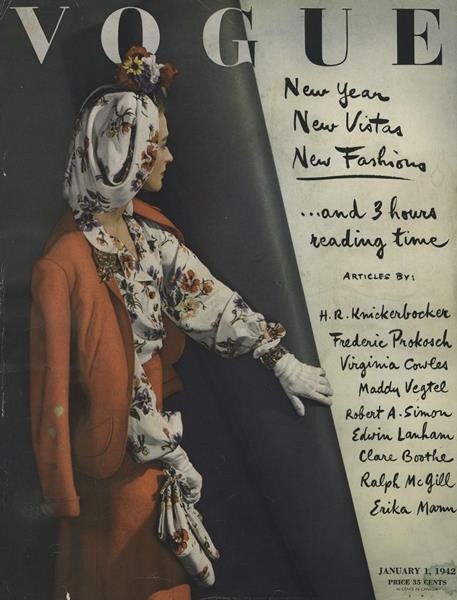
Vogue covers captured this attention to detail. In January 1942, the cover featured a look with a floral turban: the fabric’s pattern echoes the clothing, while the red outerwear creates a striking contrast. Even a small piece of fabric framing the face offers room for color and individuality. This cover appears in Vogue’s retrospective on the history of the turban.
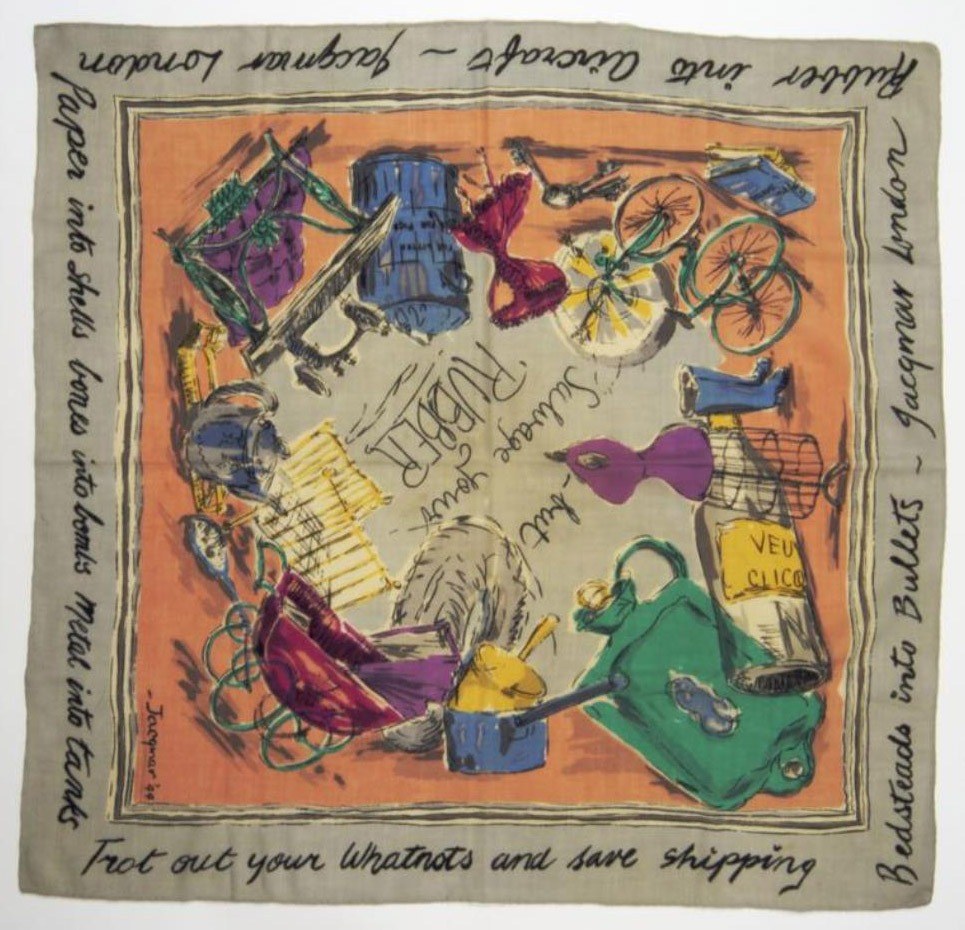
Wartime prints could also tell the story of the war itself. The British company Jacqmar created scarves with patriotic slogans and designs reflecting the front line and everyday life on the home front. The “Salvage Your Rubber” design, for example, called attention to collecting materials for reuse. Fabric became a way to carry a message.
According to Imperial War Museums, these scarves were made from silk, rayon or wool. They were expensive, and in Britain buying one also required two clothing coupons. This detail matters: an expressive accessory remained desirable, yet was far from within everyone’s reach.
From restrictions to the return of luxury
Change did not come overnight when the war ended. But in 1947, Christian Dior introduced a silhouette that stood apart from the restraint of wartime dress: a defined waist, a full skirt, generous volumes of fabric. The New Look brought a lavish sense of luxury back to fashion. The famous Bar jacket, as described by Vogue, was made from silk shantung.
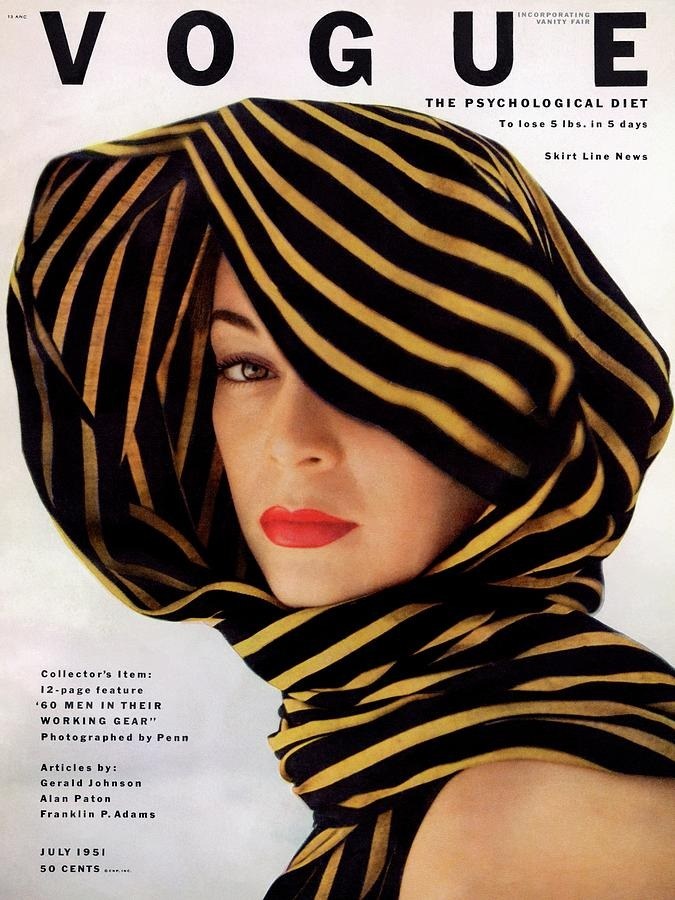
In the 1950s, scarves and draped headwear continued to make a statement in magazine imagery. On the July 1, 1951 cover of Vogue, Jean Patchett was photographed by Clifford Coffin wearing a striped rebozo, a wide shawl. Here, the stripes and folds of fabric shape the composition around her face.
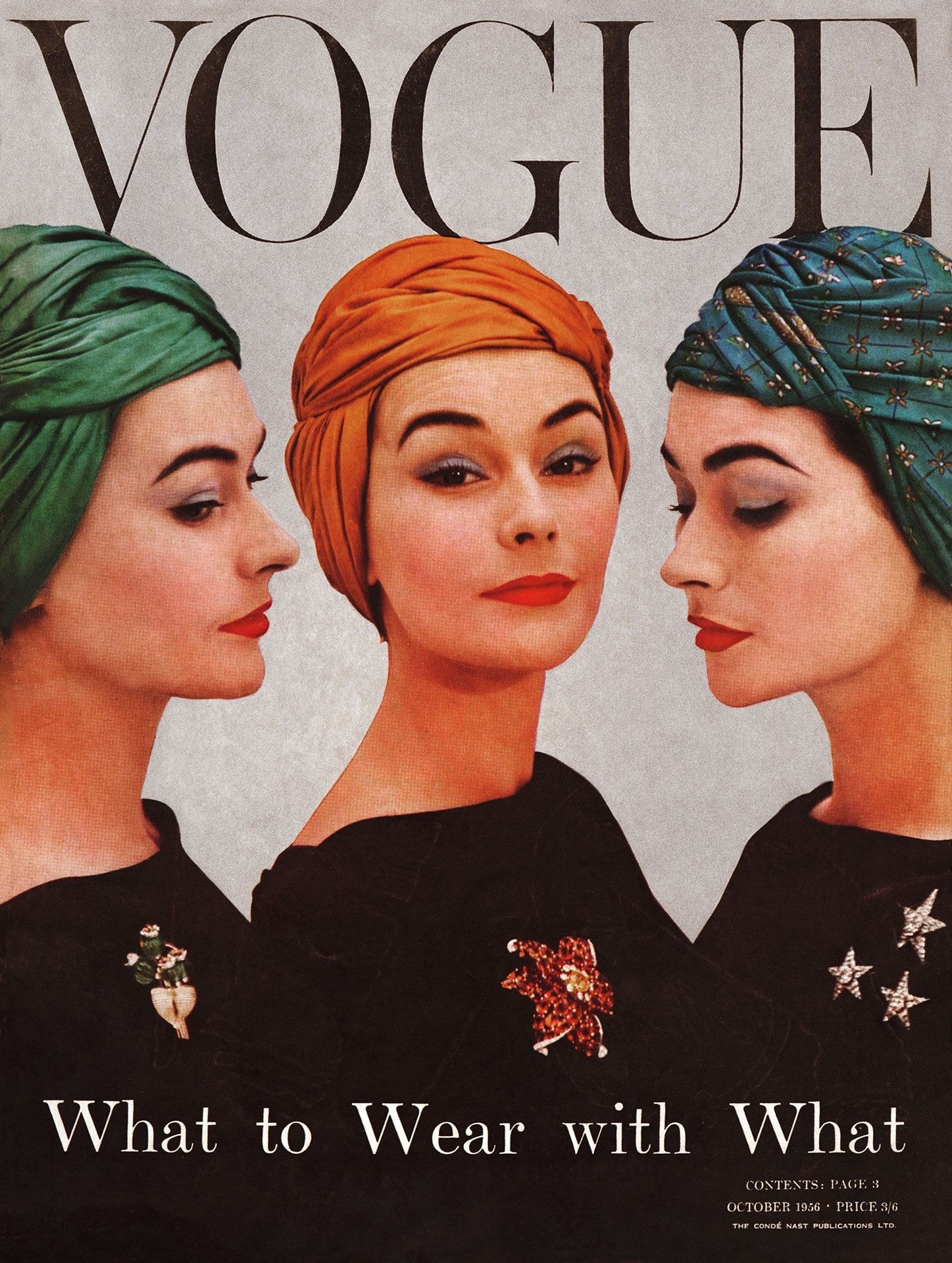
On the October 1956 cover of British Vogue, three models wear different turbans. Color, pattern and the way the fabric is arranged create three distinct personalities.
These covers presented an aspirational way of life, rather than the everyday reality of all women. Nor do we always know the composition of the fabrics shown. Yet they preserve an observation central to our story: a small piece of fabric could set the mood of an entire look.
Beauty that
doesn’t have to wait
Today, for many women in Ukraine, the question of their own desires feels especially pressing.
Our experience cannot be fully equated with that of another generation. But we know what it means to live a life where plans depend on air raid alerts, closeness is shaped by distance, and energy has to be divided between work, family, helping others and our own exhaustion.
In this everyday reality, it can be difficult to feel free. Sometimes even a small desire calls for permission from within: to buy something you love, to wear your favorite color, to feel beautiful.
A woman does not have to be composed, strong or elegantly dressed every day. She has the right to be tired, to feel low, to spend a day without thinking about her appearance. And she has just as much right to take pleasure in her own reflection. To beauty without guilt.
The touch of silk cannot erase anxiety or bring back what has been lost. But a cherished piece can become a small, personal gesture: today, I made room for my own desires too.
Seven prints.
Seven steps towards yourself
It was from these feelings that we at OBIIMY created our new SOLO collection, “A Journey to Yourself.”
We wanted to express how difficult it is for a woman to preserve her inner freedom during war. And how much it matters to leave room for her individuality, her sensuality and her desire to feel beautiful, above all for herself.
The collection features seven prints. Each marks a separate step on the journey to yourself. That journey can unfold at its own pace: sometimes there is strength for change; sometimes, only for a small choice in favor of something that brings joy.
As with the scarves of the past, the pattern holds meaning for us. In SOLO, it speaks to a woman’s inner experience, her search for herself, and the possibility of listening to her own desires.
We created this collection with a woman in mind whose daily responsibilities leave a whole inner world unseen. Her desires deserve attention now.
Perhaps today, the journey to yourself begins with a simple gesture: choosing a scarf, touching its soft fabric, tying it just the way you want.

